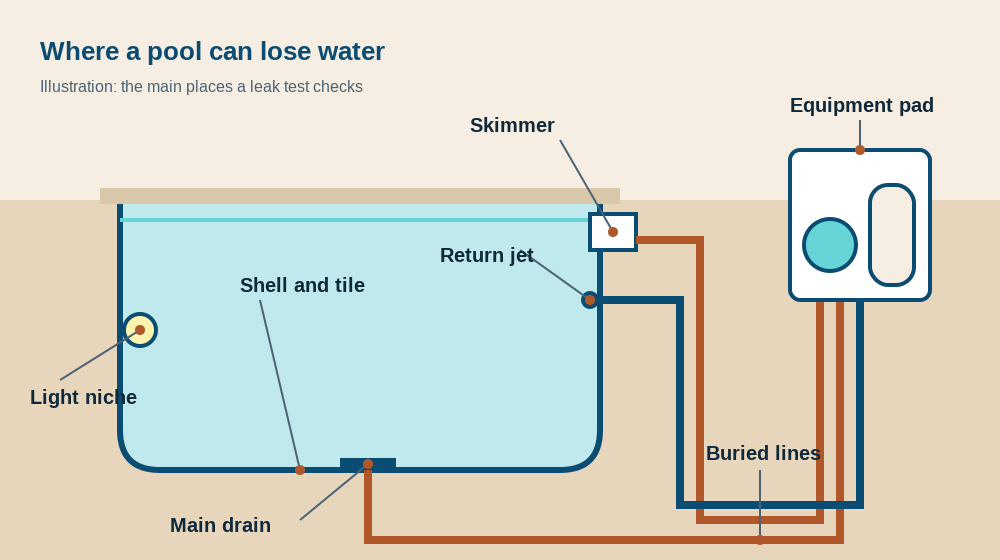
When a specialist talks about your leak, they usually sort it into one of two groups. A plumbing leak is in the pipes and fittings that carry water to and from the equipment. A structural leak is an opening in the pool itself. Knowing the difference helps you read the test results and the repair quote.
Plumbing leaks
Your pool's water goes on a loop. It leaves through the skimmer and main drain, travels under the deck to the pump and filter, and comes back through the return jets. Every joint and length of pipe on that loop is a place water can escape.
Some of that pipe is buried under the deck, so a leak there stays hidden. HomeGuide's repair guide lists underground plumbing among the places leaks most often turn up, and prices that repair at $1,000 to $4,000 nationally, because getting to the pipe takes work (HomeGuide).
Structural leaks
A structural leak is an opening in the shell: a crack in the plaster or concrete, a gap behind the tile line, or a seal that failed where something passes through the wall. The light niche, the skimmer throat, the return fittings and the main drain all pass through the shell, so their edges are common places to check.
These leaks can often be found with a dye test. The guide on cracks and light niche leaks covers them in detail.
Clues that point one way or the other
No clue is proof, but a few help a specialist decide where to start.
- Loses more with the pump running: often the lines that return water to the pool, since they're under pressure while the pump runs.
- Loses more with the pump off: often the suction side or the shell.
- Stops dropping at the same level every time: the water may be leaking out through something at that height, like the skimmer or a light.
- Wet ground, settling pavers or a spongy lawn near the pool: possibly a buried line.
Wet ground, the deck and the soil
Water from a buried line has to go somewhere. It may show up as a patch of yard that stays green or soft, a damp spot in the deck joint, or pavers that start to sink. A gap opening between the deck and the coping is worth noting too.
Take photos with a date and something for scale, and show them to the specialist. Don't dig to look for the pipe yourself. Buried lines often run close to electrical and gas lines for the equipment.
Why it matters for the repair
The two kinds of leak are fixed in different ways and priced differently. A structural leak at a fitting may be a patch or a seal. A plumbing leak under the deck may mean opening a section of deck.
That's why the test comes first. A pool leak detection visit finds which kind you have before anyone quotes the fix.