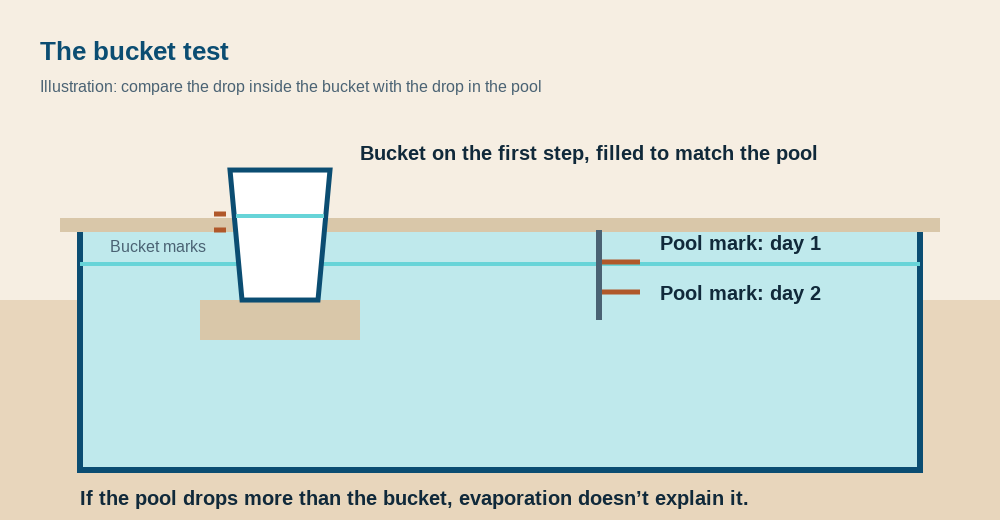
A bucket test answers one question: is the pool losing more water than evaporation alone would take? A bucket on the pool step sits in the same sun, heat and wind as the pool, so it loses water the same way. If the pool drops more, the extra is leaving some other way.
What you need
A clean five-gallon bucket, a strip of tape or a waterproof marker, and a weight such as a couple of bricks or rocks if your step is deep. Pick a day with no rain in the forecast and no pool party planned.
Step by step
Do every step on the same day, and leave everything alone for 24 hours afterward.
- Turn off the autofill so it can't top up the pool during the test. Most autofills have their own shutoff valve on the fill line.
- Make sure the pool is at its normal level, up in the middle of the skimmer opening.
- Set the bucket on the first or second step so most of it sits in the pool water. Add the weight inside if it wants to float.
- Fill the bucket from the pool until the water inside matches the pool's level outside.
- Mark the water line inside the bucket. Mark the pool's water line on the outside of the bucket too, or on the skimmer or tile.
- Run the pump on its normal schedule and don't swim, backwash or add water.
- After 24 hours, measure how far each mark has dropped.
Reading the result
If both drops are about the same, the pool is losing water to evaporation. Nothing else is needed.
If the pool dropped clearly more than the bucket, the difference is leaving through something besides the surface. Write down both numbers and the date. That's the single most useful fact a leak specialist can get from you, and it's worth reading the signs of a leak to see what else to note.
Run it twice: pump on, then pump off
Once you know the pool is losing water, a second test tells you more. Run one 24-hour test with the pump on its usual schedule and another with the pump off the whole time. Keep everything else the same.
Pool techs use the comparison as a starting clue. More loss with the pump running can point toward the lines that push water back into the pool. More loss with the pump off can point toward the suction side or the shell. It isn't proof, and the specialist will test to confirm, but it saves them time.
After rain or a monsoon storm
Rain adds water to the pool, so a test that runs through a storm can make a leaking pool look sound. In monsoon season, measure on dry days and wait a day or two after a storm before you set the bucket out.
Storms also send runoff through washes and across open desert, and that can leave low spots in a yard damp for days. Wet ground right after a storm isn't proof of a leak, especially on lots near a wash.
A spot that stays wet through a dry week, with no rain and the sprinklers off, is different. Photograph it with the date and show the specialist, along with your bucket test numbers.
Things that spoil the result
Rain, swimmers, backwashing, a running autofill, and a bucket left in full sun out of the water will all skew the numbers. So will a bucket that tips or moves. If any of those happened, start again the next day.
If the test confirms a loss, have it checked. A pool leak detection visit finds where the water is going.