Once you know the pool is losing water, the next question is where. Two tests do most of that work. A dye test shows where water is leaving the shell. A pressure test checks the pipes you can't see. One of them is safe to try yourself, and one is not.
How a dye test works
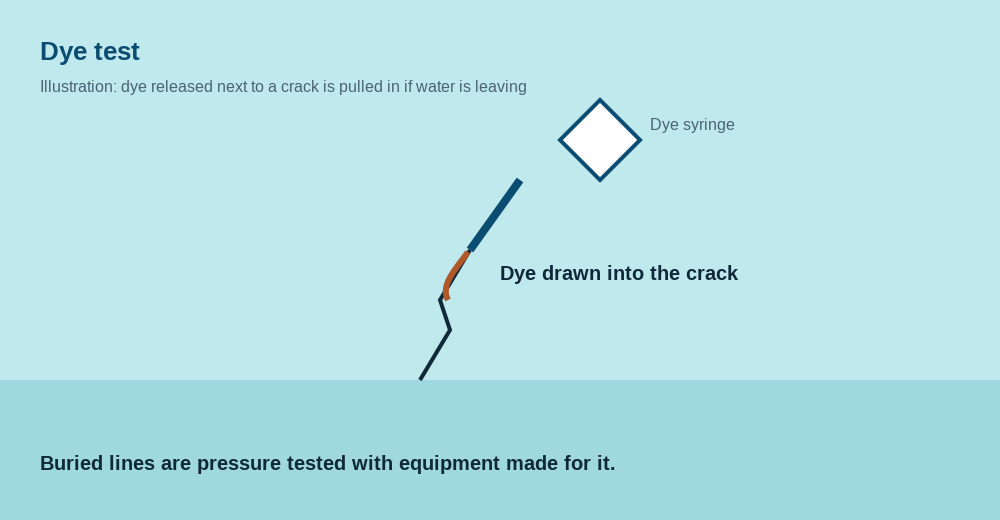
Water leaving the pool moves toward the opening, even when you can't see it moving. Release a little dye right next to a suspected spot and still water carries it nowhere. If the spot is leaking, the dye gets pulled in.
It works on cracks, the tile line, the light niche, return fittings, the skimmer throat and the gap around steps. Pool leak dye is sold for exactly this, usually in a small squeeze bottle or syringe.
Trying a dye test yourself
Turn the pump off and wait for the water to go completely still. Get close to the suspected spot without stirring the water, and release a small amount of dye right at it. Watch for a few seconds.
If the dye drifts and spreads, that spot is probably fine. If it streams into a crack or behind a fitting, you've found an opening. Photograph it and tell the specialist. Stay out of deep water if you're not a confident swimmer, and never test around the main drain or a light while the pump or the light is on.
Pressure tests are for specialists
Buried lines can't be dyed. To test them, a specialist plugs each line at the pool end and pressurizes it with equipment made for the job, then watches whether it holds. A line that loses pressure has a leak somewhere along it.
Don't try this with a shop air compressor or a garden hose rig. Pool fittings aren't meant to be pressurized by hand, and a plug or fitting that lets go under pressure can hurt you. Leave it to the pool leak detection visit.
Other tools a specialist may use
HomeGuide's cost guide mentions electronic sensors, ultrasound and infrared cameras as some of the more advanced methods, and notes they can raise the price. Ask what methods the test includes before it starts. The cost guide covers what changes the price.