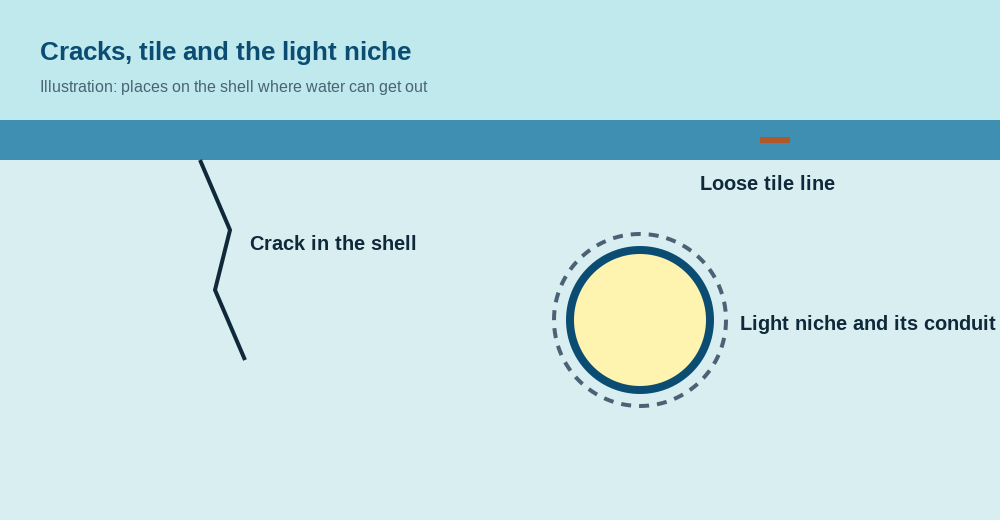
The shell is the pool itself: the concrete or plaster, the tile band at the water line, and every fitting that passes through it. A structural leak is an opening somewhere in that shell. Some are easy to see. Others hide behind the tile or inside the light.
Cracks in the shell
Not every crack leaks. Fine surface cracks in plaster are common and often cosmetic. A crack that runs through the shell, or one that keeps getting longer, is more worrying.
Photograph each crack with a coin or tape measure for scale, and date the photo. Taking the same photo a month later shows whether it's growing. A dye test right at the crack, with the pump off, can show whether water is moving into it.
The tile line and coping
Tile at the water line takes sun, heat and changing water levels every day. Loose or missing tiles and cracked grout can let water get behind the tile band. A gap opening between the coping and the deck is worth noting too.
HomeGuide puts tile or coping repair at $500 to $1,500 nationally.
The light niche
Most underwater lights sit in a niche, a pocket in the wall with a conduit running back to the electrical. The niche is a penetration through the shell, so its edges and its conduit can leak. If the level keeps stopping at the light, that's a clue.
Never open the light fixture or pull it out of the niche yourself. It's an electrical fixture underwater. HomeGuide puts pool light replacement at $500 to $1,700 nationally if the fixture itself needs replacing.
Other penetrations
Anything that passes through the shell has a seal: return fittings, the skimmer throat, steps, ladder and rail anchors, and the main drain. Each is checked during a test. The guide on skimmer, return and main drain leaks covers the plumbing fittings.
Getting it confirmed
A crack you can see may not be the leak you have, and a pool can leak in more than one place. A pool leak detection test checks the whole shell and the plumbing, so the repair goes where the water actually leaves.