Deer Valley is one of Phoenix's 15 urban villages, covering about 57 square miles of the city's northwest side. It takes in Deer Valley Airport, Adobe Dam Regional Park, the Deer Valley Petroglyph Preserve and the Adobe Mountains. With that much ground, it holds homes and pools from many different decades.
Know your pool's age first
In a village this big, your neighbor's pool may be twenty years older or newer than yours. The age tells the specialist what kind of plumbing and equipment to expect, so find it before the test.
The Census Bureau's 2020 to 2024 survey shows the spread: the median home in the 85053 ZIP code was built around 1978 and in 85027 around 1988, while in 85083 and 85085, further north, it was around 2005 and 2009. Those numbers count homes, not pools, and a pool can be younger than its house. Still, if your home dates from the 1970s or 1980s and the pool came with it, ask the specialist to treat the lines under the deck as possibly original.
Check your closing papers, the seller's disclosures, or old permits. If you don't know, say so in the form. A rough decade is still useful.
- The decade the pool was built, roughly
- The city named on your property tax bill
- Where earlier repairs were made on the pool or its lines
- Whether a wash or open land borders the yard
Older pools and repair history
An older pool has usually been worked on in pieces: a new pump here, a resurface there, a patched line somewhere under the deck. Each repair leaves joints between old and new parts. Tell the specialist where earlier repairs were. A leak near an old repair is worth checking first.
Phoenix, Glendale or Peoria?
Deer Valley borders Glendale and Peoria, and the city lines don't always follow the streets you'd expect. We cover addresses inside the City of Phoenix only. Check the city on your property tax bill or deed if you're near the edge.
Accepted ZIP codes in this part of town include 85027 and 85053, plus 85083 and 85085 further north.
Checking which city your home is in
Mailing addresses can say Phoenix even where the parcel sits in another city, and the reverse. The quickest check is your property tax bill or the Maricopa County Assessor's parcel search, which lists the city for each parcel. The same parcel page shows the subdivision name, the year the home was built and whether a pool is on record. That year belongs to the house, so a pool added later may be newer. Put both in the form.
If your home turns out to be in Glendale or Peoria, we can't set up the test, but the guides still apply. The bucket test and water loss log work the same anywhere.
Homes near Skunk Creek and other washes
Skunk Creek, Scatter Wash and other washes cross Deer Valley, and Adobe Dam, finished by the Army Corps of Engineers in 1982 to control Skunk Creek's flow, sits in its northwest, so a yard near a wash can stay wet after a summer storm with no pool leak behind it. The bucket test guide explains how long to wait before you measure, and your water loss notes show the specialist the pattern on dry days.
Testing pools of every age
The specialist checks the full pool, the equipment and the buried lines, with extra attention to older parts and earlier repairs. Read what a pool leak detection visit covers, then send the form with what you know about your pool's history.
Nearby
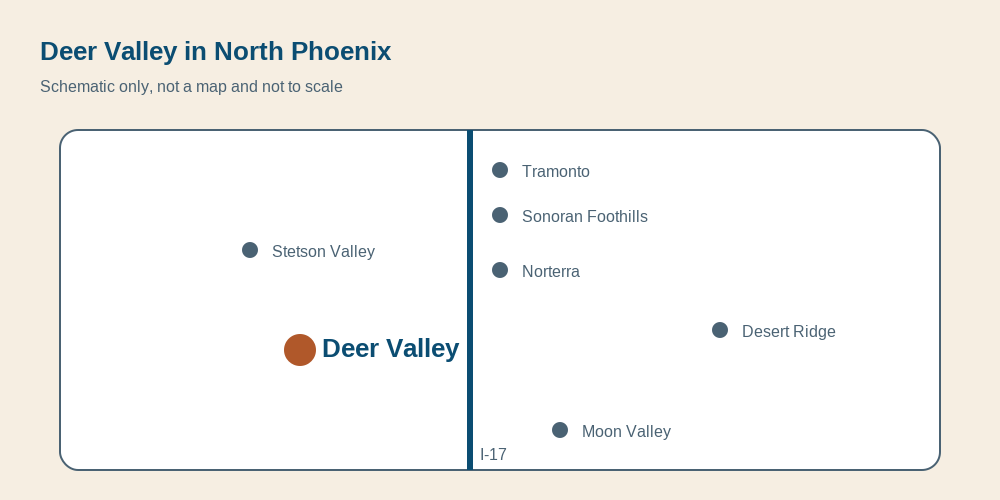
In the village's northwest corner, Stetson Valley has newer pools by the Deem Hills, and Norterra, at I-17 and Happy Valley Road, has some of the newest. To the southeast, Moon Valley has some of the oldest pools in North Phoenix.