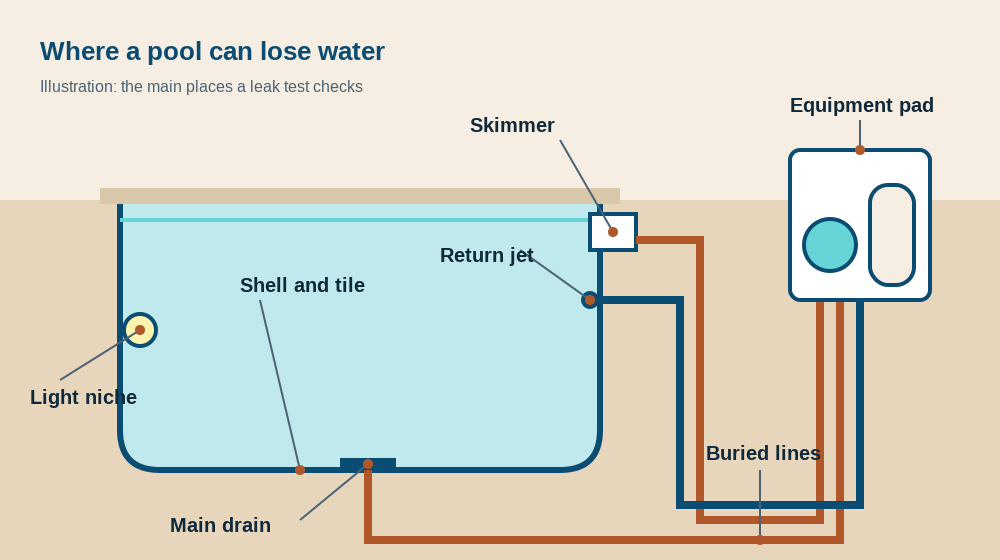
A pool that keeps losing water is either evaporating faster than you expect or leaking somewhere you can't see. A leak test answers which one, and if it's a leak, where. We set up the test with a pool leak specialist, and you get a clear answer before anyone talks about repairs.
When a leak test makes sense
Leaks aren't rare. The City of Phoenix says about one in 20 pools leak, and that a small leak of an inch a day can waste up to 100,000 gallons in a year. That's enough to fill a typical pool four times.
Evaporation is the other explanation, and in Phoenix it's a big one, so measure before you book. Our guide on telling a leak from evaporation shows what normal loss looks like here, and a bucket test gives you the number the specialist will want first.
Book a test when any of these are true:
- Your bucket test shows the pool dropping faster than the bucket.
- The autofill runs more than it used to, or the water bill jumped and nothing else changed.
- There's wet ground, a soggy patch of yard, or standing water near the pool or the equipment.
- You see new cracks, loose tile, or a gap opening between the deck and the coping.
- The pool keeps needing more chemicals, because new fill water keeps diluting the balance.
What the specialist checks
A full test looks at every place water can leave a pool. That means the pool shell and tile line, the skimmer, the return fittings, the main drain, the light niche, the equipment pad, and the plumbing that runs under the deck between the pool and the equipment.
The methods depend on the pool, and HomeGuide notes that some jobs add electronic sensors, ultrasound or infrared cameras. Our guide to dye and pressure tests explains how the two main checks work.
You get a pool that's been checked end to end, not just at the spot you suspected, which matters because a pool can leak in more than one place.
Pools with an attached spa
If your spa spills over into the pool, the two share water and often share equipment. A leak in the spa's plumbing can show up as a drop in the pool. Tell us about the spa when you send the form, so the specialist plans to check both.
Mention any recent work too: new tile, a resurface, new equipment, or a repair. A leak that starts right after work is a useful clue.
How to get ready
A few days of notes make the visit faster. Start the log from our guide on documenting water loss, and have it ready with the items below.
Before the visit, fill the pool to its normal level, unlock the gate, put pets inside, and clear a path to the equipment pad. In a townhome or condo community, check whether the pool is yours or the association's before you book.
- Your water level notes, with dates
- Your bucket test result, with dates
- Recent water bills, if the bill went up
- Photos of wet spots, cracks or drips
- Any paperwork from earlier pool repairs
What it costs
HomeGuide's national range for testing an inground pool is $400 to $1,000, and our cost guide and estimator shows what moves that number and what repairs add. Before the visit starts, ask whether the price covers any attached spa and the buried lines, since those are part of a full test.
After the test
The specialist should tell you where water is leaving, how they found it, and what they'd suggest. A small fix, like a seal at a fitting, is sometimes handled during the visit. Bigger repairs get their own visit and their own price.
Either way, you decide. Our guide on what happens after a leak is found lists the questions to ask before you approve a repair.
Where we set up tests
We cover North Phoenix neighborhoods inside the City of Phoenix, from Tramonto and Norterra near I-17 to Desert Ridge on the northeast side and Moon Valley to the south.
Pools there range from early 1960s builds in Moon Valley to ones only a few years old.
Each community has its own page in our service areas, with the details that matter for pools of that age and setting.